Prompt-Template Trials
Label quality is set almost entirely by the prompt template. Until now there was no way to change a template and find out whether the change helped, short of relabeling an entire extraction and reading the results by hand.
A trial runs one template over a fixed set of features — a panel — and records the labels it produced without writing any of them to your features. Run a second trial with a different template over the same panel, and the two are directly comparable.
This is the whole point. Running five template variants over a panel would otherwise overwrite your real labels five times, and the fifth variant would be scored against features the first four had already rewritten. Trial labels live only in the trial record.
Where templates come from
Trials test the templates you author under Templates → Labeling Templates. That panel is where the variable under test is defined.
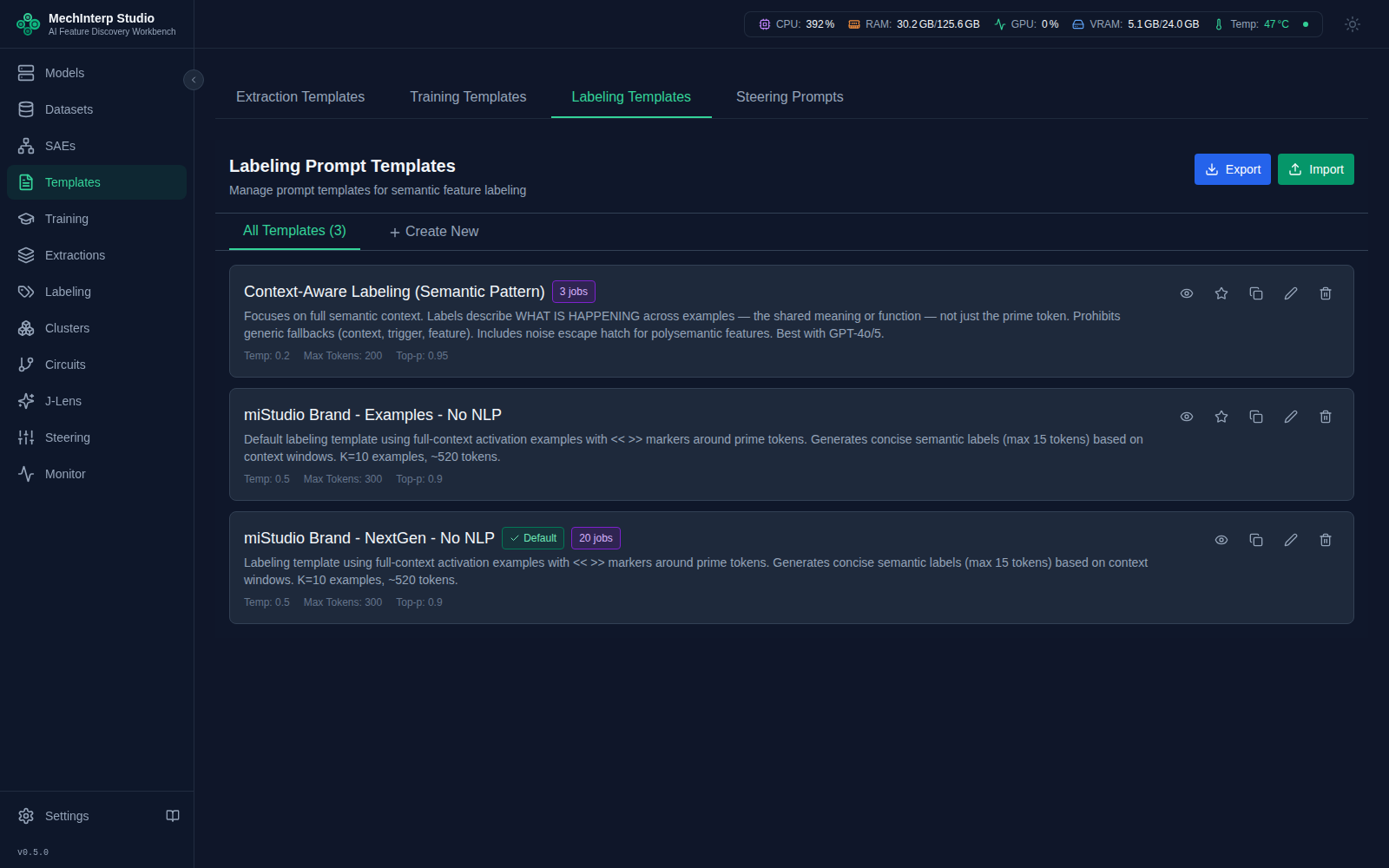
Each row shows the template's temperature, max tokens and top-p, and which one is the Default (used when a trial names no template). The job counts show how much real labeling each has already driven.
Opening Create New shows every field a trial captures:
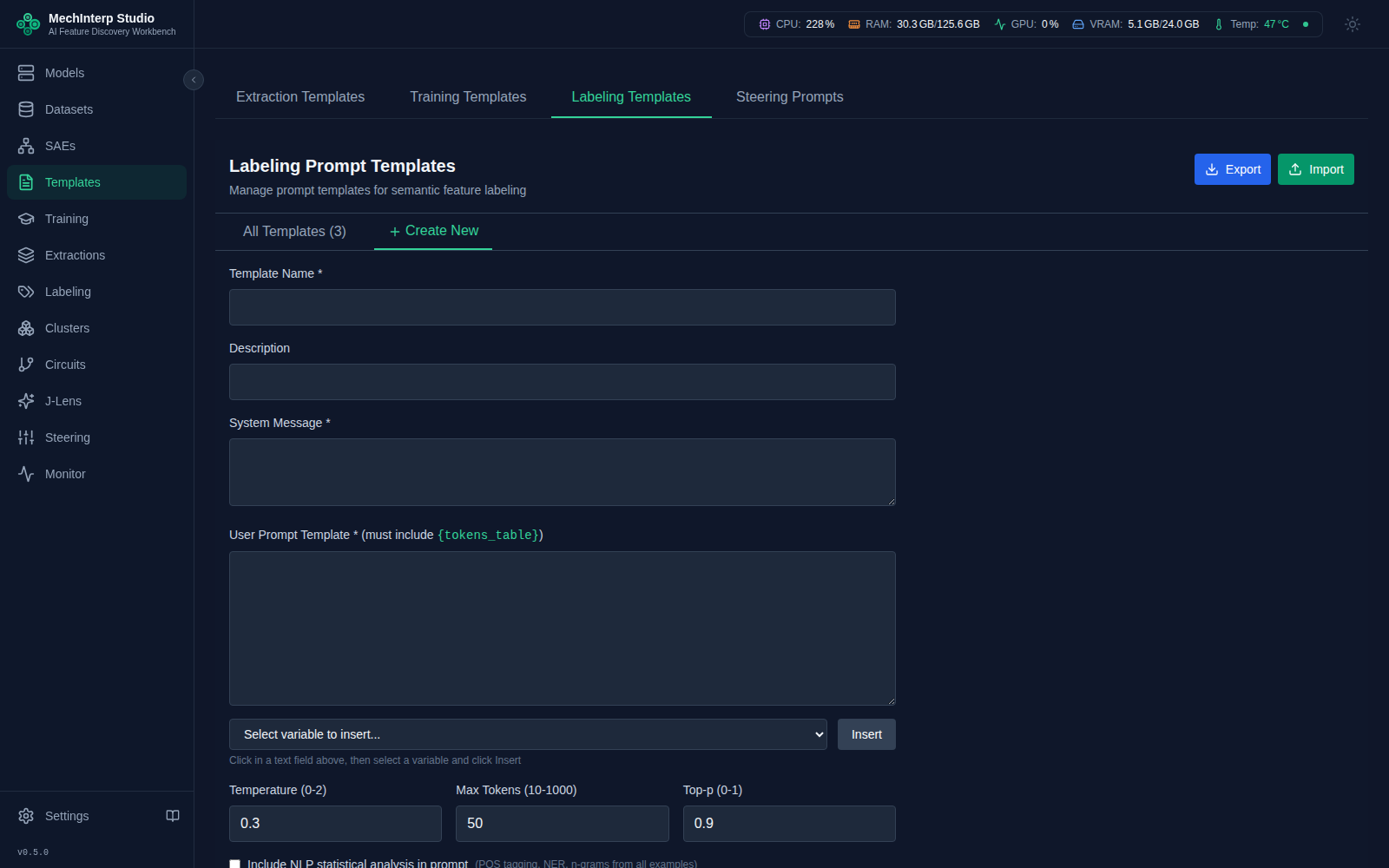
A trial freezes a complete copy of all of it — the system message, the user prompt template, the sampling parameters — not a reference. Templates are editable, so a run holding only an id would silently re-describe itself the moment someone tuned the template mid-experiment, and two runs would appear to differ by a change neither actually used.
Choosing a panel
A panel is an explicit list of feature ids from one extraction, between 1 and 200 of them.
Panel identity is content-addressed: it is a hash of the extraction id plus the sorted feature
ids. Two trials with the same panel_id therefore provably covered the same features, and a
comparison across different panels is refused rather than reconciled.
Pick features that span the range of what your SAE actually produces. A panel made only of easy, high-frequency features will rate every template highly and tell you nothing.
Running a trial
From an agent over MCP:
run_labeling_trial(
  extraction_job_id = "extr_...",
  feature_ids       = ["feat_...", "feat_...", ...],
  prompt_template_id = "lpt_...",
  name              = "baseline"
)
Or over REST:
curl -X POST http://mistudio.hitsai.local/api/v1/labeling/trials \
  -H 'Content-Type: application/json' \
  -d '{"extraction_job_id":"extr_...","feature_ids":["feat_a","feat_b"],
       "prompt_template_id":"lpt_...","name":"baseline"}'
Both return a trial_run_id. Poll get_labeling_trial (or GET /labeling/trials/{id}) for the
result.
Run a second trial over the same feature_ids with a different template, then compare.
Comparing two trials
compare_labeling_trials(run_a = "ltr_...", run_b = "ltr_...")
The comparison reports, per feature, whether the label and the category changed, plus the overall change rates.
It refuses more often than it answers, deliberately:
| situation | result |
|---|---|
| the two runs used different panels | 409 — comparing them would produce a number that looks like a template difference and is not one |
| no overlapping features | no verdict, with a reason. Comparing nothing is not comparing |
| every overlapping feature errored in one arm | inconclusive — never identical. Failed labels stringify the same way and would otherwise read as perfect agreement |
Scoring labels objectively
Change rates tell you that two templates differ, not which is better. For that, miStudio can score a label by detection: given only the label, can a judge model pick out which passages activate the feature? A good label scores well above chance; a vague one scores at chance.
Three properties make that number trustworthy, and each exists because its absence produced a wrong answer:
The ruler is pinned. The scoring prompt is a fixed, versioned constant, never one of your editable templates. The template under test varies; the instrument measuring it must not, or scores taken on different days are not comparable. A score always records the ruler version that produced it.
Negatives come from other features, and the claim is bounded. miStudio stores only each feature's top-activating passages, so a feature's own weakest examples are still positives — using them as negatives would punish a correct label. Negatives are drawn from other features instead. There is no way to certify a passage as non-activating without re-running the model, so the only claim made is that it falls below the feature's weakest stored activation. That threshold travels with every score.
A judge that fails its sanity check produces no score at all. Before scoring, the judge must
detect a token it was explicitly told to look for, and must not score well when handed a
deliberately mismatched label. Failing either yields judge_unreliable — never a low score.
Reporting a weak judge's failure as a low score would send you rewriting prompts that were already
good. If you see judge_unreliable, point the scorer at a stronger model; the 1.2B model this
cluster serves is not able to grade itself.
Reading the score
Two numbers are reported per feature, and the gap between them is the interesting part:
ba_hard— scored against negatives that contain the feature's own top token in a different sense. This is the headline: it separates "fires on the word running" from "fires on physical locomotion".ba_easy— scored against unrelated passages.
A label that only names the surface token aces the easy set and fails the hard one. Measured on a worked example:
| label under test | overall | ba_hard | ba_easy |
|---|---|---|---|
| the concept ("locomotion on foot") | 1.00 | 1.00 | 1.00 |
| the surface token ("the word running") | 0.75 | 0.50 | 1.00 |
| an empty label | 0.50 | 0.50 | 0.50 |
ba_easy − ba_hard is how much of a label's apparent quality is just naming the token.
How big a difference is real
A panel comparison reports a confidence interval and the smallest difference the panel could have resolved. Roughly 30 features resolves about 6 balanced-accuracy points. A three-point gap between two templates on a thirty-feature panel is not a result, and the comparison says so rather than declaring a winner.
Keeping a trial honest
Two things are enforced that are easy to get wrong:
- The example order is seeded per panel and feature, so two trials present identical passages in identical positions. Without this the prompt differs between runs and the template is not the only variable.
- Every batch shown to the judge contains both activating and non-activating passages, while the order within a batch stays unpredictable. A single-class batch is answered uniformly by a correct judge and would be misread as a broken one; a predictable order lets a judge score well by guessing.
What a trial does not do
- It does not write labels. To adopt a winning label, apply it explicitly — over MCP that is
update_feature_label, which does persist and carriesmcp_agentprovenance. - It does not test detection templates. A template flagged as a detection/scoring template is refused as a trial subject: it is the ruler, not the thing being measured.
Related
- Auto-Labeling — the bulk labeling run a trial is optimizing
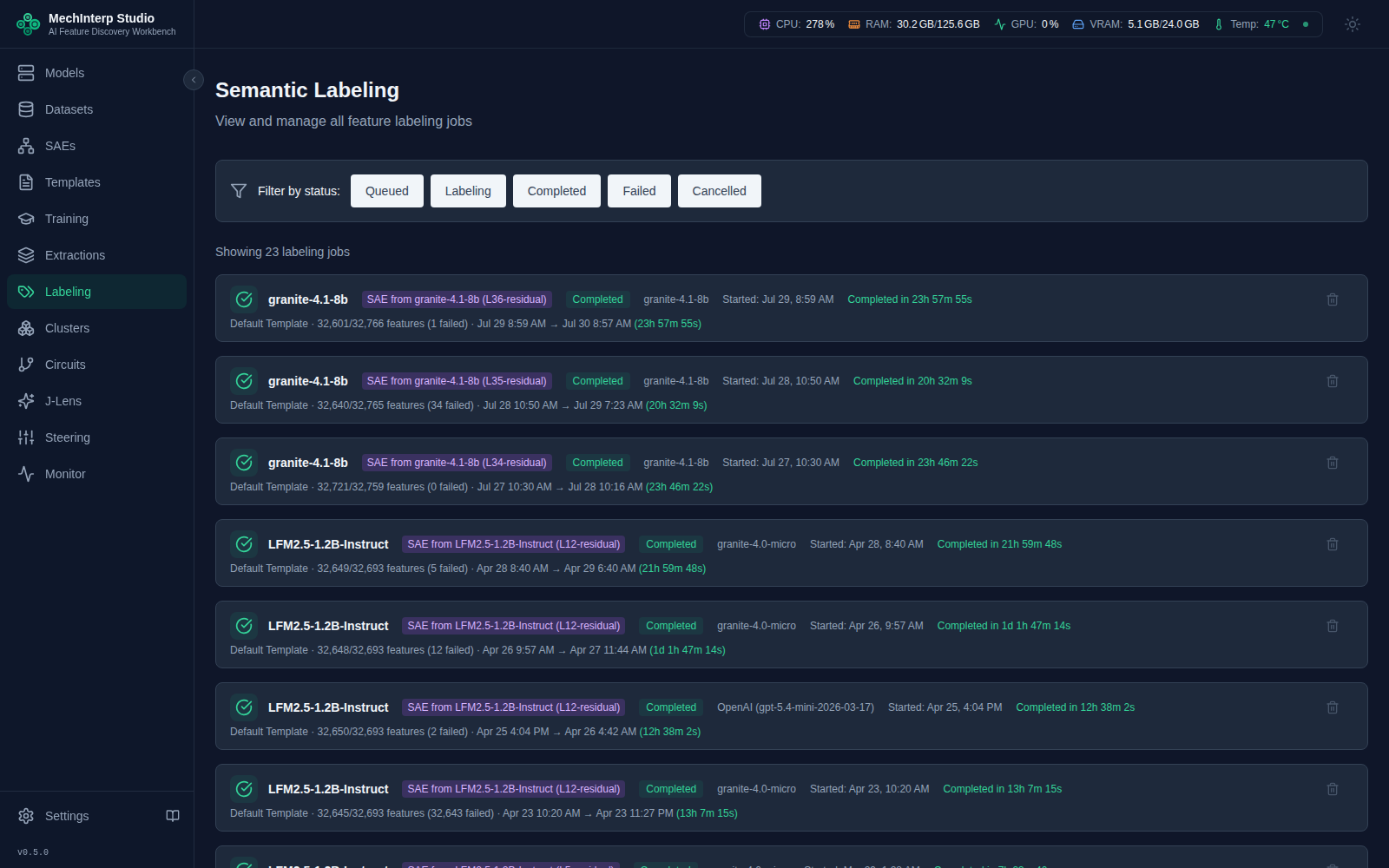
- Enhanced Per-Feature Labeling — the deeper two-pass path
- Labeling API reference